
REVIEW: The Lions of Zion

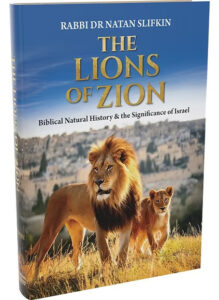 Natan Slifkin, The Lions of Zion: Biblical Natural History and the Significance of Israel (Biblical Museum of Natural History, 2025), 380 pp.
For many readers of TRADITION, Rabbi Dr. Natan Slifkin, is well known as the object of a 2004 attempt to ban his books on Torah and science. The ban, signed by 22 rabbinic figures of the Haredi world (some very well-known), affirmed that Slifkin’s books were “full of heresy…and ridicule the foundations of our Emunah.” Over the last two years Slifkin has been at the forefront of English-language attempts to refute Haredi justifications for failure to serve in the IDF. I strongly suspect that aside from these issues, Slifkin (whom I know and admire) would probably prefer to be known as the founder and guiding light of the Biblical Museum of Natural History, situated near Beit Shemesh, and not as a defender of Jewish rationalism and of the State of Israel.
It is Slifkin’s work on “his” museum which motivated him to write his latest book, The Lions of Zion. Like the museum itself (and unlike many of Slifkin’s earlier writings) the book seeks to steer clear of internal Jewish polemics (at least in its first half). It has two aims: to show how the natural world of the Torah demonstrates the Jewish People’s connection to the Land of Israel and to refute attacks on Israel which use alleged Israeli “sins” against nature. The book is highly engaging, often amusing, and always deeply interesting (aided by many color photographs and illustrations). But more than that, the book is truly important. The first part deals with nature in the Bible and in Jewish history, demonstrating how the Jewish people not only returned to their ancient homeland, but also, through customs, rituals, and names, kept alive our connection to the Land through the generations. Slifkin also shows how two millennia of Exile have led to strange misunderstandings (about the size of olives, for example) and misidentification of Biblical terms. This is done respectfully, not polemically.
| Read Alex S. Ozar’s review of Natan Slifkin’s “Rationalism vs. Mysticism: Schisms in Traditional Jewish Thought,” TRADITION 54:3 (Summer 2022). |
The first half of the book contains occasional vignettes, all of which are of great interest. For one example, Colonel John Patterson (1867–1947), was a famous lion hunter in Africa who wrote a book on his experiences, The Man-Eaters of Tsavo. This book led him to a connection with Teddy Roosevelt, an avid hunter, and later with Harry Truman. Patterson took advantage of his connection with Roosevelt to create and command both the Zion Mule Corps and the Jewish Legion in World War I, and later to lobby Truman in support of Israel. “The Lion Hunter of Zion,” as Slifkin calls him, sought to train Jewish soldiers again for World War II but ran into British opposition. But the soldiers he trained for the First World War became the kernel of trained soldiers of the Hagana, and later played an important role in the early days of the IDF. Of particular interest, Patterson was very friendly with the parents of an Israeli hero, who named their child after him. That child was Yoni Netanyahu, the hero of Entebbe. To the end of his days, Patterson was a friend of the Jewish people and the Zionist movement.
Even though Jews of Europe had no direct acquaintance with the geography, fauna, and flora of the Land of Israel, they sought to maintain the connection with Eretz Yisrael, sometimes with amusing results. Thus, we have European animals showing up in the works of commentators and translators. Slifkin treats these issues in a respectful and occasionally charming fashion. Here is one example. We are all familiar with Avot (5:20): “Yehuda ben Teima said: Be bold as a namer, as powerful as an aryeh, as light as a nesher, and swift as a tzvi to fulfill the will of your Father in heaven.” Sefaria translates this as follows: “Judah ben Tema said: Be strong as a leopard, and swift as an eagle, and fleet as a gazelle, and brave as a lion, to do the will of your Father who is in heaven.” Chabad.org has the following: “Yehudah the son of Teima would say: Be bold as a leopard, light as an eagle, fleeting as a deer and mighty as a lion to do the will of your Father in Heaven.” Both the Tur and the Kitzur Shulhan Arukh open with the Avot text. It is thus a well-known passage, finding visual expression in Jewish art throughout our history.
But do these authors, translators, and artists actually understand the Avot passage? Leopards used to be common in Biblical Israel, as were lions. But what sort of leopard and what sort of lion? For that we need Natan Slifkin. His analyses teach us about the fauna of Biblical Israel, and about rabbinic values. Many of us think that nesher = eagle as in the Sefaria and Chabad translations. But eagles are heavy birds! That is one of the many reasons that Slifkin teaches us that the nesher is a griffon vulture, a bird with a huge wingspan which soars on thermals, lightly, without much effort. Similarly, with tzvi. Ashkenazi Jews, familiar with European fauna, think it means deer, as in the common name Tzvi Hirsch (Hirsch in Yiddish means deer). Slifkin demonstrates that the Mishna means gazelle and has a marvelous story about the survival of gazelles in Israel.
Slifkin’s discussion of shofrot, olives, and matza will surprise no one who has followed his blogposts for years. Eschewing polemics, he convincingly and respectfully shows that European poskim, who never saw an olive, were mistaken in their view of how big a kezayit is (chapters six and seven). One of Slifkin’s well-known hobby horses is with kosher locusts, one of many fascinating discussions in the book. Apropos kosher locusts, Slifkin could have found grist for his mill in Halikhot Teiman, by Rabbi Joseph Kafih (1917–2000), the great Maimonidean commentator and translator.
One further example (of many) of how The Lions of Zion enriches the reader’s Jewish experience: Why do we recite Psalm 104 (barkhi nafshi) on Rosh Hodesh? Slifkin points out that Rosh Hodesh marks a dramatic change in the night sky, testifying to God’s creation and continued creative activity. Psalm 104 “marvels at everything from animals to plants to natural landscapes to the very universe itself.” Concerning animals—lions, whales, storks, wild asses, ya’elim (ibexes), and shefanim (hyraxes, not rabbits) are all mentioned in the psalm. It turns out that there are very few places in the world other than Eretz Yisrael in which all these animals are found in the same landscape. Barkhi nafshi thus focuses our attention not only on the natural world, but on nature in the Land of Israel.
Summarizing his 150 pages on “biblical natural history,” Slifkin writes:
The Bible expresses the historical and cultural connection of the Jewish people, the animals and plants of their ancestral homeland. And today, the Jewish people can feel this connection., not just as Diaspora Jews longing for it from afar, but as a living, intimate physical and spiritual relationship, in the revitalized ancient Jewish homeland of the Land of Israel (334).
This is a beautiful statement of the values of Religious Zionism.

Natan Slifkin at his Biblical Museum of Natural History (courtesy)
Unlike the first part of the book, the second part, on “Israel, Nature and Politics,” is not at all amusing. Here Slifkin takes deadly aim at enemies of Israel, all too often themselves Jews or even former Israelis, who, among many other sins, misrepresent conservation work in Israel as attempts to justify Zionist “rewriting” of the natural history of the Land of Israel. Slifkin’s talents as a polemicist come to the fore here. So, too, his deep knowledge of the history of Zionism and of the Zionist enterprise, in addition to his detailed familiarity with anti-Zionist attacks on Israel. Slifkin takes on a series of anti-Israel polemicists, all of whom suffer from what I see as “Israel Derangement Syndrome.” In their eyes, Israeli conservation actions become examples of “settler colonialism,” or “greenwashing”; Middle Eastern flora and fauna become narrowly “Palestinian,” Jewish connection to the Land of Israel is denied, etc.
Given the irrational and obsessive nature of attempts to delegitimize Israel, Slifkin’s reasoned and fact-based refutations are even more impressive. It is a shame that a man of his intellect and talents was forced to become an expert on so much nonsense to defend Israel from its hate-filled enemies. I think that going into further detail here about Slifkin’s important and convincing defense of Israel is unnecessary—readers of TRADITION do not need it (I hope)!
The Lions of Zion appealed to me, a retired academic, on many levels. A very urban Jew, living in the Land of Israel for half a lifetime, the book encouraged me to pay greater attention to my non-urban and very Jewish environment. The book also enriches one’s prayer experience—so many of our prayers focus on God’s creation. For anyone needing help in combating our anti-Zionist enemies, the second half of the book is an important resource. If the first half of the book focuses on Judaism and nature, the second half focuses on Zionism and nature. Both parts work together in a richly satisfying fashion.
Menachem Kellner is Wolfson Professor Emeritus of Jewish Thought at the University of Haifa and recently retired founding chair of Shalem College’s Department of Philosophy and Jewish Thought