
RESPONSE: How Hebraic an Inkling?
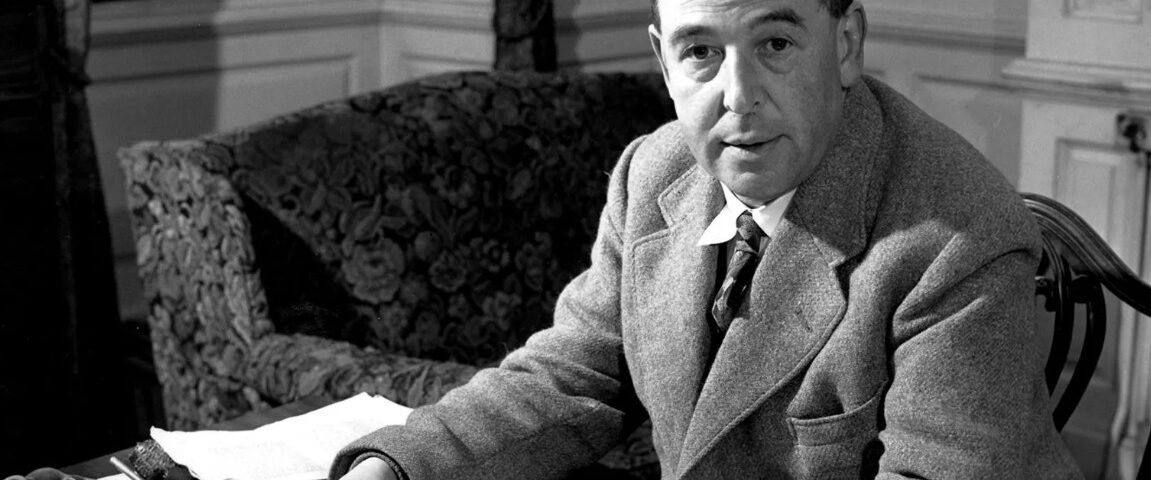

C.S. Lewis
To the Editor:
In what is much more than a Review Essay, Rabbi Mark Gottlieb describes his spiritual journey as an Orthodox Jew enamored by the great Christian theologian and apologist C.S. Lewis (“C.S. Lewis and the Jews: A Marriage Made in Heaven or a Great Divorce?,” TRADITION [Summer 2025]). In doing so he addresses a question that I too have been asked, by myself and others, “Why would an Orthodox Jew value the writings of a Christian thinker?” Gottlieb answers this question much more comprehensively and cogently than I ever could, and for that I am in his debt.
That question, however, begs another which is the main topic of Gottlieb’s review, what was C.S. Lewis’ attitude towards Orthodox Jews like Gottlieb, and I presume many readers of TRADITION (myself included)?
For the first time this question was recently addressed in a well-researched, fascinating book by P.H. Brazier, A Hebraic Inkling: C.S. Lewis on Judaism and the Jews (Pickwick, 2021). In his review of this work, Gottlieb raises a number of issues that deserve independent treatment. In no way do I address them all here, but I would like to address some points he raises.
To start, I would comment on Brazier’s goal in writing his book. As the subtitle suggests, the author writes, “The aim of this book is to examine precisely what C.S. Lewis believed and wrote about the ancient Hebrews, their scriptures, their status as God’s chosen people, and about today’s Jews” (3). In other words, Lewis’ judgment of the Jewish people. However, we find Brazier outlines another aim for his work: “The question … then is, in what manner, and how evidently Hebraic was C.S. Lewis, and how does this awareness/consciousness change over the course of his life?” (12). In other words, Brazier judges Lewis against a metric of Hebraicism. He defines a Hebraic Christian as a one who embraces the Jewish roots of his faith. They “are children of Abraham by faith, even if gentile by birth….” Brazier asserts that Lewis affirmed the ideal of a Hebraic Christian.
Brazier uses this second aim as the envelope and yardstick for his first. He consistently judges Lewis (not always favorably) against his ideal Hebraic Christian and through that analysis explores Lewis’ approach to Judaism. Brazier’s ultimate conclusion is that, “It is fair to say that he was, in effect, a Hebraic Inkling!” (253; for two decades Lewis belonged to an Oxford literary group, together with his friend J.R.R. Tolkien, called “The Inklings”). But this is not very convincing. Even Brazier, based on his numerous criticisms of Lewis, admits it is only “fair” to say he is a Hebraic Inkling, it is not “obviously” or “conclusively” so. Furthermore, as Gottlieb notes, Brazier’s readings of Lewis are best attempts to cast Lewis as Hebraic, and many of these readings lack solid evidence. With that in mind, Gottlieb discusses whether or not Lewis displayed belief in supersessionism, and maintains that Lewis is at least a soft-supersessionist which he defines as “the insistence that the Jewish covenant is not completed until it fulfills itself in Christ.” However, in the context of A Hebraic Inkling the first question to ask should be: what does a Hebraic Christian believe about supersessionism? Only then can we ask whether Lewis measures up to that definition.
Brazier forwards his belief on the relationship between Christianity and Judaism in a number of statements. For example, he notes,
Gentile Christians are still gentiles—in the flesh, by birth. God has dealt differently with Jews from gentiles but such [gentile] believers are enfolded into God’s chosen people. As gentiles, our belonging, enfolding, in Israel is not to be seen only as a gain—a matter of rights and privileges. No; we are obliged to observe a godly way of life that has its origin in God’s relationship with Abraham, and with the chosen people. Further, we are obliged to relate as family to the Jewish community to whom our faith has combined us, fused us…. As Barth noted, it is not a question of the Jews rejecting the Messiah, though some have, temporarily, not acknowledged him—yet. Furthermore, the Jewish person is (from a Christian perspective) implicitly in Yeshua, the second person of the trinity, because for thousands of years they have listened to him as God…. (196).
Later Brazier concludes, “In some ways the relationship between Christians and Jews might be seen in the parable of the two sons. Many Christians say ‘I will’ but either don’t or redefine the will of the Father according to their desires; while many Jews deny the divine nature of the Son, Yeshua, saying ‘I won’t’ but are obedient to the Father, where the Father and the Son are one. Israel says no to Christ, but many Jews conform to the will of God in Christ. And in both cases the answer is not final till the eschaton…” (250). As a Jew, it is easy to take offense at Brazier’s stance. I (and Gottlieb) certainly have no plans to ever accept that Jesus is God. Nonetheless, I personally do not see how a Christian can be more liberal than that and still be considered a Christian. They believe Jesus is God, and must therefore believe that we Jews are mistaken for not believing so. The question at hand is what happens in the meantime. Brazier believes that Jews (both those “for Jesus,” who believe he is God and those who do not) should be Orthodox, follow halakha in all of its parameters, and develop a relationship with God. Furthermore, Brazier speaks highly of the Second Vatican Council in which the Catholic Church stated, “[the Jews] will be judged according to the traditions of Moses, at the eschaton” (Brazier, 83). I do not believe a more positive Christian stance on Judaism is possible.
The question is, does Lewis believe the same?
Brazier generally (though not completely) believes that Lewis does. Gottlieb makes the case that Brazier’s readings are speculative to the point of wishfulness and that Lewis does not. I would lean towards Gottlieb’s view, though I think there is insufficient evidence to know for sure and that Lewis did, at a minimum, acknowledge the importance of the ancient Hebrews and took a strong stance against blatant anti-Semitism.
Building on Gottlieb’s comments let me further note that much is made by Brazier of Lewis’ wife, the convert from Judaism, Joy Davidman. In Brazier’s final chapter he portrays this marriage as a culmination of Lewis’ Hebraicism. Actually I found that the most “Hebraic” part of Brazier’s entire work is the “lomdus” demonstrated in his footnotes on this section in which he attempts to demonstrate that the marriage between Lewis and Davidman did not violate Christian law. Perhaps Lewis actually was influenced positively about Judaism due to Davidman, but Davidman, as demonstrated in her work on the Decalogue, Smoke on the Mountain: An Interpretation of the Ten Commandments in Terms of Today (Westminster Press, 1954), is, as Gottlieb describes, “neither proud, knowledgeable, nor observant in her Judaism.” Gottlieb is being too generous (and Brazier is completely incorrect): Davidman, while certainly halakhically Jewish was an avowed atheist until her conversion to Anglicansim, and her book demonstrates ignorance of and scorn towards Jews and Judaism.
Here is not the place to fully demonstrate this, but Gottlieb points to Lewis’ foreward to Smoke on the Mountain, as proof of Lewis’ supersessionist attitude. There Lewis writes that the only “normal” human being is a Jew who recognizes Christ, suggesting that Judaism is not fulfilled until it accepts Jesus as God. I have to admit, I am not sure that the attitude expressed in this statement is very different from Brazier’s and I don’t see this as negative towards Jews or Judaism. After all, every Christian must say the Jews are incorrect for not accepting Jesus. What I found much less “Hebraic” in Lewis’ foreword to Smoke on the Mountain, is the following statement which, to me, strongly suggests that, at least to that point in time (which wa sprior to their marriage), he was not at all positively influenced towards Judaism by Davidman:
What should a Jewish Christian write on if not the Law? But notice that the choice of subject means no relapse into mere Judaism, nothing that need alarm the most Pauline of us. The author knows quite as well as any of us that Mr. Legality will never bring us to the Celestial City and has got over the fallacies of Moralism fairly early in life. She had good opportunities for studying it at close quarters. She knows that only love can fulfill the Law.
This is a statement that Brazier could never write and never agree with. If anything it suggests that Davidman was less “Hebraic” than Lewis, which I believe she was.
I claim that Lewis himself is incorrect in his reading of Davidman’s book. Her goal is not to demonstrate that love fulfills the law, but that the law (at least the Jewish understanding of it) is now rejected entirely in favor of moral proverbs and mantras. Hence, guarding the Sabbath becomes, “stopping all the pursuits we engage in for necessity not pleasure,” and honoring one’s parents becomes having a functional, loving family. This is one of Christianity’s favorite attacks on Judaism. Judaism is all rules and laws, while Christianity speaks more inwardly to divine ideals. Today, of course, in a time of post-modernism and progressivism, we have seen that such ideals, lacking rules, are invoked for causes of great wickedness and evil. And, in fact, Lewis already foresaw this. In what he thought was his greatest work of fiction, Till We Have Faces (1956), Queen Orual clearly writes the laws of the land (not moral platitudes) in stone, placed in the middle of her kingdom for all to see (as the Greeks did). This is a great step towards justice and righteousness. Interestingly, Davidman is said to have greatly influenced the writing of this book, but to suggest that she could have positively influenced Lewis on Jews, seems to be a pipe dream.
Gottlieb correctly spends time on Brazier’s examination of Lewis’ Reflections on the Psalms. Let me immediately note that a Jewish perspective on Lewis’ analysis of Psalms is sorely lacking and perhaps Gottlieb will take up this task in the near future. Brazier’s criticism of this work of Lewis is incredibly on target and addresses almost all of my own critiques of Lewis in that book. Hence, Gottlieb does well to acknowledge this stance of Brazier.
To add an additional element to the discussion before I close, let me make another critique of Lewis which again, I believe, demonstrates some non-Hebraicity. He excoriates the psalmist for praying that God bring down His judgment. Lewis contrasts this with the Christian who fears God’s judgment. Obviously, as anyone who has ever spent an hour in synagogue during the High Holidays knows, Jews also fear His judgment. But more importantly, we do rejoice, for how could a religious person not pray for God to reveal Himself to the world and mete out justice to all creatures? Even if we ourselves are going to fall short, isn’t it worthwhile for truth to shine forth? It is true, Jews, as Lewis himself notes, are less worried about their own final judgement than in bringing God into the world. It is disappointing that he does not seem to agree.
With the above, I want to again thank Rabbi Gottlieb for his profound analysis and encourage those open to the idea to struggle with the works of C.S. Lewis.
Yaakov S. Weinstein is a physicist for The MITRE Corporation and an Orthodox Jewish fan of C.S. Lewis.