
The BEST: Caps for Sale
“The BEST” series features writers considering what elements in our culture still inspire us to live better and seeks to share what we find that might still be described as “the best that has been thought and said.” Click here to read about “The BEST” and to see the index of all columns in this series.
 Summary
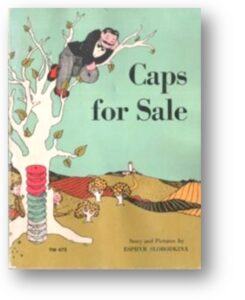
Caps for Sale: A Tale of a Peddler, Some Monkeys and Their Monkey Business is a children’s picture book by Esphyr Slobodkina published in the United States in 1940. The book has sold more than six million copies and has been translated into over a dozen languages. It is beloved by children worldwide, perhaps because, as Slobdokina wrote in her memoir, “The verbal patterns and the patterns of behavior we present to children…are likely to influence them for the rest of their lives. These aesthetic impressions, just like the moral teachings of early childhood, remain indelible.”
Why this is The BEST
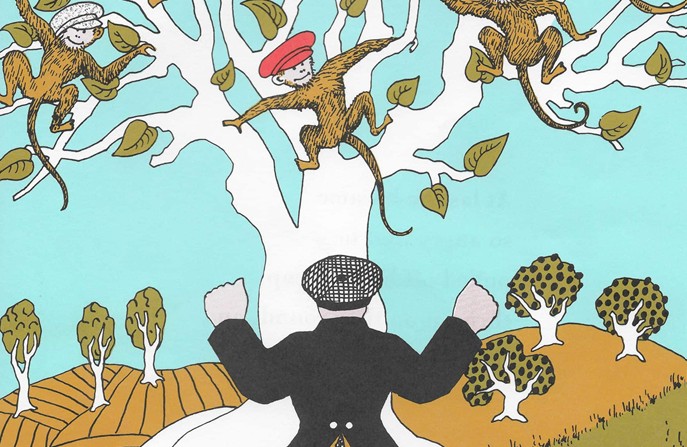
Nearing a century after its publication, Caps for Sale remains one of the best books to read aloud to children. This timeless story of a peddler with his caps piled high on his head—first his own checkered cap, then the gray caps, then the brown caps, then the blue caps, and then the red caps on the very top—features a narrative that was first documented in a North Carolinian newspaper in 1789. As the Wilmington Centinel relates, a sailor who had just returned from the Labrador coast in Canada went on shore to sell a number of red woolen caps. Tired, he lay down to rest under the shade of a plantain tree; when he woke, he discovered that the monkeys in the tree above him were wearing his caps. After several fruitless attempts to regain his caps, he fell into a fit of exasperation and rage, pulled his one remaining cap off his head, and threw it on the ground—only to discover that the observant monkeys did the same.
It is unclear whether the author and illustrator of Caps for Sale, the Russian-born Jewish-American artist and author Esphyr Slobodkina, ever encountered this news story firsthand. Perhaps it was a folktale that circulated more widely, and was merely adapted for children by her. Indeed, the nineteenth-century rabbi and scholar Yosef Hayyim of Baghdad, known as the Ben Ish Hai, recorded a nearly identical in the context of a discussion of the tendency of demons to imitate human beings, in a “monkey see, monkey do” manner. Ben Ish Hai wrote, “And I have heard stories that a sailor did such a trick to the monkeys who took the hats that were flat on the land in front of the ship, and by such a trick he [the sailor] took all the hats that the monkeys took, because monkeys are naturally inclined to do what the man in front of them does, for they want to resemble humans” (Ben Yehoyada, Megilla 3a).
Slobodkina’s children’s book, then, is an imitation of a story that is in itself about imitation—the monkeys in her book copy the peddler when he stamps his feet and shakes his hands and yells, “You monkeys you, you give me back my caps.” Indeed, when I read this book to my children, I play the role of the peddler as my children imitate the monkeys, who stamp their feet and shake their hands and say, “Tsz tsz tsz.” And so my children imitate the monkeys, who imitate the peddler, whom I try to imitate as I read his lines aloud in Caps for Sale. But at the same time, I am also imitating my father, who read this story to me when I was a child nearly forty years ago; indeed, I can still hear his voice when I imitate the monkeys imitating the peddler in successive layers of mimicry that date back to Slobodkina, who wrote and illustrated her book in Great Neck, Long Island, not far from where I grew up.
And so why is it the best? Caps for Sale is a story that reminds us of the pleasure of reading aloud in an age where devices are increasingly taking the place of books and YouTube recordings are increasingly replacing the parent’s voice. Even after countless rereading, my children still smile each time we come to the part of the book where the monkeys imitate the peddler and throw their caps on the ground. Perhaps this story is so enduring in its appeal because being a child has been, and always will be, about imitation. The child learns by watching the parent, joining the mimetic tradition (to borrow a phrase popularized in the pages of this journal). Or, as the ancient rabbis put it, ma’aseh avot siman la-banim—the actions of the parents are a model for their children. I read Caps for Sale to my children using the same cadences and intonations with which my father read it to me; I can only hope that someday, one day, my children will grow up to do the same.
Ilana Kurshan, winner of the Sami Rohr Prize for Jewish Literature, is the author of, most recently, Children of the Book (reviewed in our Summer 2025 issue).