
The BEST: The Far Side
Summary
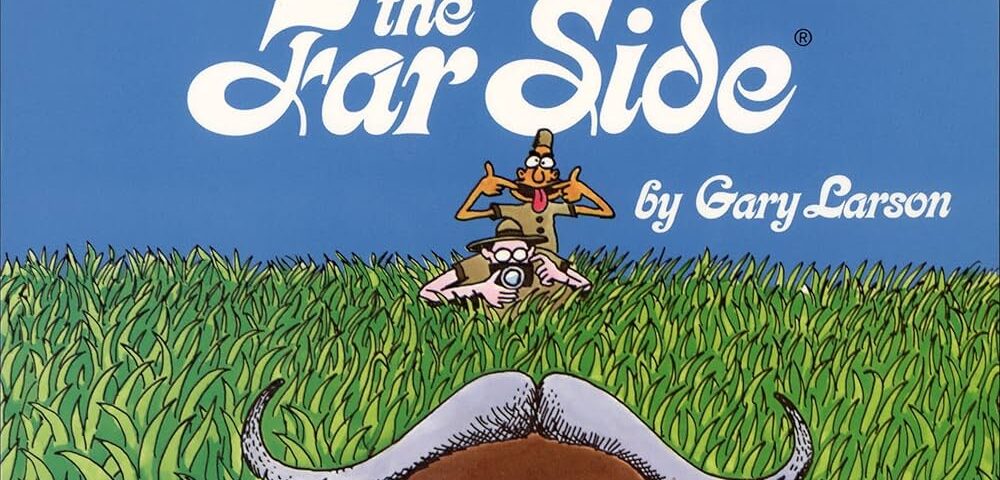
The Far Side by Gary Larson is a single-panel comic that ran from 1980–1995. By the end of its run, Larson had produced over 4,300 cartoons, and the strip was syndicated in nearly two thousand daily newspapers. The humor in The Far Side tends towards the silly and surrealistic: Puns and plays on popular sayings abound, crudely drawn humans find themselves in ridiculous situations, and perhaps most significantly for our discussion, anthropomorphized cows, sheep, insects, and snakes occupy the “human” world, while still maintaining certain key elements of their animal nature.
A June 22, 1988, Larson cartoon depicts a family of snakes sitting around the dining room table to meal of rats, beginning their meal, as the mother makes a request of one of the younger snakes: “Bobby, please jiggle Grandpa’s rat so it looks alive.”

Clcik to enlarge
Why it’s The BEST
Despite the silliness of his illustrations and absurdity of his humor, there are two important ways in which Larson demonstrates that he is not merely trying to provide quick laugh. Firstly, he never condescends to his audience. The themes explored in The Far Side, and the manner in which they are explored (even in the small real estate of a single panel), assume that the reader has at least rudimentary familiarity with sciences and humanities, ranging from anthropology to zoology, with a good deal of archeology, biology, and chemistry along the way. His cartoons often depict scientists at work and contain references to figures including Darwin, Einstein, Freud, and Carl Sagan. Beyond the sciences, references to history, art, a wide range of musical genres, pop culture, Americana, and even a smattering of light theology (perhaps even lighthearted blasphemy) all point to the same conclusion: While The Far Side is not what one would call a cerebral work, it is not afraid to demonstrate its creator’s intelligence, and to acknowledge the same in its reader.
Larson also transcends mere silliness by demonstrating that he is not contemptuous of his subject matter. The Far Side is populated by strange characters, nerds, and a wide array of humans, animals, amoebas, and extraterrestrial, often making all sorts of fatefully bad decisions. While it is clear that both the cartoonist and the reader are having fun at their expense, the mockery is gentle even if the situations are sometimes extreme, and one gets the sense that Larson approaches these characters with affection and a large degree of compassion.
This brings us to our cartoon. Like many of Larson’s animal-based scenes, we are looking in at a situation that is inherently absurd: A family of snakes gathers around a mid-century American dinner table (note mom’s trademark eyeglasses a hair-do). The room is decorated with a rug and a picture hangs on the wall. The snakes sit in chairs, and the table is set with a white tablecloth. Alongside the mother are two children, and finally, Grandpa, depicted in the same manner as many of the elderly men (and their animal counterparts) in The Far Side: Hunched over, bespectacled, and with wrinkled gums which once held teeth. Dinner has been served: A dead rat has been placed in front of each of the diners at the table. There is, however an unspoken history: Grandpa was apparently not always domesticated. He misses living in the wild, and he especially misses the hunt. He does not understand, and presumably does not want this lifestyle. In this way, the cartoon presents us with a theme that is ubiquitous in our culture and in our lived experiences. The world is constantly in flux, it is likely that at some point, we will feel alienated, perhaps not recognize it at all, and we will be filled with nostalgia for an old world that no longer exists.
As Chaim Strauchler recently pointed out in this column, looking at a work of art by Leonardo da Vinci, a person who ages, who feels that the world has left him behind, can be thrown into existential turmoil. When the Psalmist implores “Do not cast me away in my old age,” he acknowledges that part of the experience of aging is that sense of alienation, the feeling that there may no longer be room for me in this world. Much of the messaging in our culture conveys that it is the responsibility of the older generation to keep up with those changes or be left behind. In his caption, Larson turns that trope on its head: Rather than lecturing Grandpa, young Bobby snake is asked to perform one small, humane and compassionate act—jiggle grandpa’s rat. For one brief moment, give grands the feeling, perhaps only an illusion, that he is still hunting in the wild, that he is still relevant, and that the world has not rejected him. To go from Leonardo to Larson is quite literally to trek from the sublime to the farthest side of the ridiculous, but so be it as we seek to learn from “the best.”
This message is reflective of one that Rabbi Yehoshua ben Levi gave to his children. The Talmud records that he reminded the next generation to “Be careful [to continue to show respect to] a sage who has lost his wisdom due to ones [literally: under duress, Rashi notes that this could be due to illness], since we say that both the whole Tablets and the broken Tablets were placed in the ark” (Berakhot 8b). By invoking the image of the broken luhot smashed by Moses, R. Yehoshua ben Levi is guiding his children to create circles of compassion. The space of the aron was sufficient to contain both the luhot and the shivrei lukot; those that currently, effectively conveyed God’s message to his people, and those that once did but can no longer (see Bava Batra 14a–b). The spaces that we create in our own lives must reflect this as well. The world naturally has room for those in their prime, who actively contribute and occupy the present moment with confidence and authority. Alongside them, a compassionate community makes room for those who once held the same place and now find themselves lost, and wonder about their own worth.
Just as both sets of Tablets—broken and whole—occupy the same Ark, the Talmud teaches that the greatest comfort for someone who may be in his twilight is for those who are currently in their prime to broadcast that they all belong together, in one community. Larson would say that even if we never again go on the hunt, at least someone will be next to us to jiggle our rat.
Rabbi Uri Goldstein is Rav HaMidrasha at Midreshet Amudim in Jerusalem.